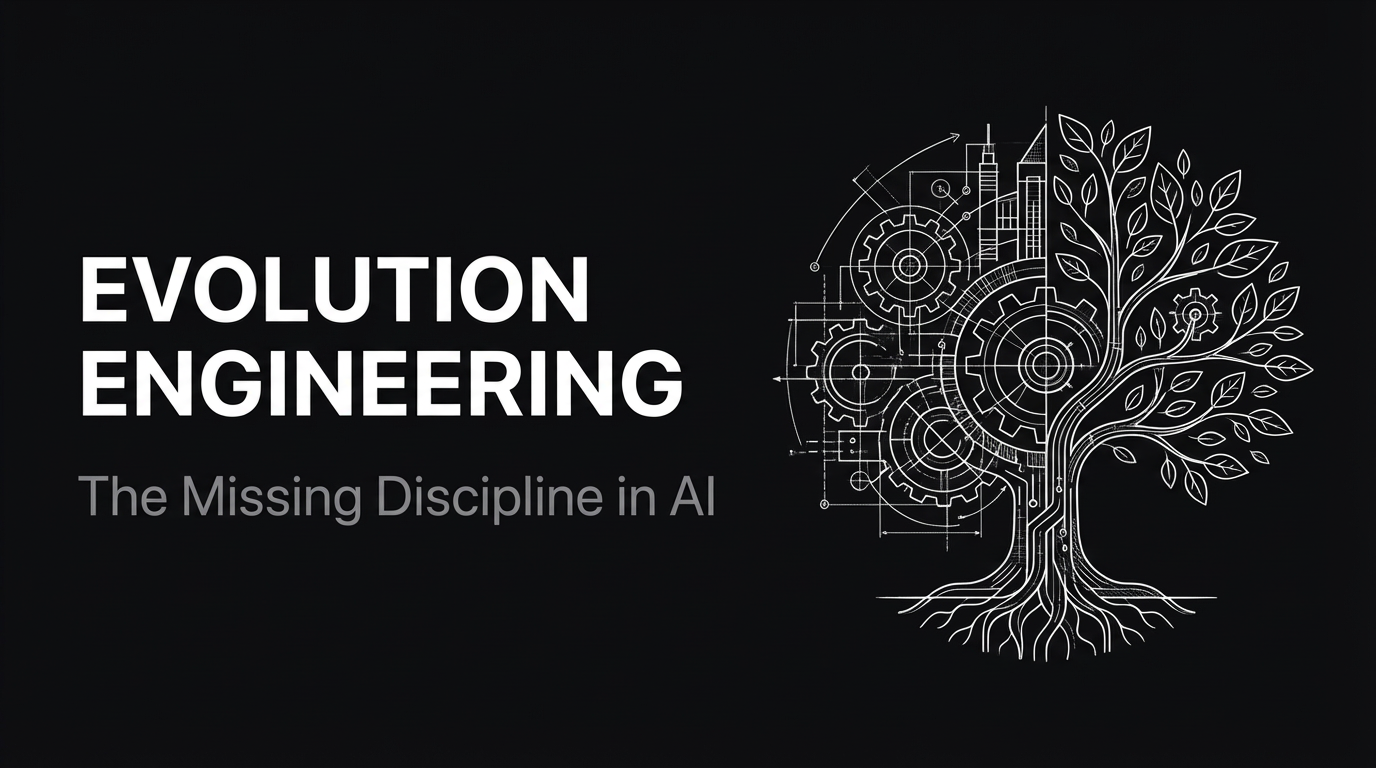
Prompt Engineering taught AI how to listen. Context Engineering taught it what to know. Harness Engineering taught it how to act. Each paradigm solved a real layer of the AI stack — and each left one layer untouched.
That layer is capability itself. Not how you talk to AI, not what AI knows, not how AI is orchestrated — but what AI can do, and how that set of capabilities improves over time.
This post argues that this gap defines a new engineering discipline. We call it Evolution Engineering.
The Four Layers
To understand the gap, trace the progression:
Prompt Engineering (2022–2024) solved the interface problem. LLMs are sensitive to phrasing — the same question asked differently yields dramatically different outputs. Prompt Engineering developed techniques (chain-of-thought, few-shot, system messages) to make LLM responses reliable and useful. The unit of work is the prompt.
Context Engineering (2025) solved the knowledge problem. A prompt alone isn't enough — the model needs the right information at the right time. Context Engineering manages the full context window: RAG pipelines, memory systems, tool results, conversation history. The unit of work is the context window. Andrej Karpathy articulated it well: "I would not say prompt engineering is that important. The much more important thing is context engineering."
Harness Engineering (2025–2026) solved the orchestration problem. Context tells AI what to know; a harness tells AI how to act. Harness systems coordinate multi-step agent workflows, manage tool calling, handle error recovery, and ensure agents execute reliably in production. The unit of work is the agent harness — the scaffolding that turns an LLM from a reasoning engine into an acting entity.
Each paradigm is valuable. Each is necessary. And each coexists — Context Engineering didn't kill Prompt Engineering; Harness Engineering didn't kill Context Engineering. They stack.
But notice what's missing.
The Gap
Who defines what AI can do?
Today, the answer is: a human, manually. A developer writes a tool function. A team packages a Skill. An engineer hardcodes an API wrapper. The capabilities are hand-crafted, frozen at the moment of creation, and maintained through manual updates.
This works at small scale. It doesn't work when:
- You have hundreds of capability modules and no quantitative way to know which version of "summarize document" actually performs best
- An improvement discovered by one agent can't propagate to other agents that need the same capability
- A malicious or low-quality capability module has no formal evaluation gate before it runs in production
- Capabilities that worked last month silently degrade as upstream APIs change, and nothing detects the drift
The root cause is structural: we treat AI capabilities as static artifacts to manage, not as living units to cultivate.
Prompt Engineering gave AI ears. Context Engineering gave AI memory. Harness Engineering gave AI hands. But nobody gave AI DNA — a mechanism for capabilities to be born, tested, selected, transferred, and evolved.
The Thesis: Evolution Engineering
Evolution Engineering is the discipline of designing systems where AI capabilities improve through evolutionary mechanisms rather than manual engineering.
The core insight: instead of building every capability by hand, you design the selection environment — the fitness criteria, the competition arena, the propagation channels, the safety immune system — and let capabilities evolve within it.
This is not metaphor. It's a direct application of the same principles that have driven biological adaptation for 4 billion years, operationalized for software.
The shift it implies:
| Traditional | Evolution Engineering | |
|---|---|---|
| How capabilities improve | Developer rewrites code | Fitness-driven selection replaces underperformers |
| How capabilities spread | Manual install/copy | High-fitness modules propagate automatically |
| How quality is measured | Subjective ("it works for me") | Quantitative fitness function F(g) |
| How security works | Per-application policy | Collective immune system |
| Practitioner's job | Build capabilities | Design selection environments |
The last row is key. An Evolution Engineer doesn't write every capability from scratch. They design the rules of the game — what fitness means, how competition works, what safety thresholds must be met — and the capabilities emerge, compete, and improve within those rules.
This mirrors a pattern from other engineering disciplines. DevOps didn't replace development — it created a new discipline around infrastructure. MLOps didn't replace machine learning — it created a new discipline around model lifecycle. Evolution Engineering doesn't replace Prompt/Context/Harness Engineering — it creates a new discipline around capability lifecycle.
What Makes It Formal
A paradigm without formalism is just branding. Evolution Engineering rests on four formal pillars:
1. The Gene: Atomic Capability Unit
A Gene is the minimal transferable logic unit. It satisfies three axioms:
- Functional cohesion — solves one atomic problem
- Interface self-sufficiency — interacts only through a declared schema (Phenotype)
- Independent evaluability — its fitness and security can be scored in isolation, without other modules
Formally, a Gene g is defined by the tuple:
$$ g = (id, \text{express}, \text{phenotype}, \text{healthCheck}) $$
where id = H(content(g)) is a content-addressable hash, express: Context → Result is the execution function, phenotype declares capabilities and constraints, and healthCheck provides self-diagnosis.
Content-addressability means identity is determined by behavior, not by name or author. Two developers who independently write the same logic produce the same Gene.
2. The Fitness Function: Quantitative Selection Pressure
Every Gene is scored by a ratio-based fitness function:
$$ F(g) = \frac{S_r \cdot \log(1 + C_{util}) \cdot (1 + R_{rob})}{L \cdot R_{cost}} $$
where S_r is success rate, C_util is input-space coverage, R_rob is robustness against adversarial inputs, L is latency, and R_cost is resource cost.
The multiplicative structure is deliberate: a Gene with zero reliability or zero security scores zero overall, regardless of other dimensions. There is no "fast but broken" — the function enforces holistic quality.
Security is evaluated independently through a verification score V(g), creating two independent defensive lines. A Gene must exceed thresholds on both to be admitted.
3. The Arena: Competition as Selection
Genes in the same functional domain compete on standardized benchmarks. The Arena provides the selection pressure that drives evolution:
- Same inputs, same evaluation criteria, blind comparison
- Top performers surface automatically
- Underperformers fall below the admission threshold and exit
- Rankings update continuously as new challengers enter
This is computational natural selection. Not human curation, not popularity voting — fitness-proportional selection.
4. Horizontal Logic Transfer: Cross-Agent Propagation
When one agent discovers or develops a high-fitness Gene, that Gene can propagate to other agents that need the same capability. Transfer is proportional to fitness — better Genes spread faster.
This mechanism is directly inspired by Horizontal Gene Transfer (HGT) in bdelloid rotifers — microscopic animals that have thrived for 40 million years of asexual reproduction by incorporating genetic material from other species. Up to 10% of their expressed genes are of non-metazoan origin. This isn't a metaphor — it's a structural isomorphism: the Gene model, the fitness-proportional propagation, and the collective immunity system all map directly to biological mechanisms that have been validated by 4 billion years of evolution.
What Evolution Engineering Is Not
Not AutoML. AutoML optimizes model hyperparameters and architectures within a fixed training loop. Evolution Engineering operates at the capability layer — above the model, at the level of what an agent can do with its reasoning ability.
Not Meta-Learning. Meta-learning trains models to learn faster on new tasks. Evolution Engineering doesn't modify the model at all — it evolves the modular capabilities that agents compose to solve problems.
Not Self-Improving Agents (Voyager, ADA). Self-improvement systems let individual agents refine their own behavior. Evolution Engineering operates at the population level — improvements propagate across agents, creating collective intelligence rather than isolated self-optimization.
Not a replacement for the other paradigms. You still need good prompts, well-managed context, and robust harness systems. Evolution Engineering adds a layer; it doesn't subtract one.
The distinguishing properties: modular capability units (not monolithic models), quantitative fitness (not subjective evaluation), cross-agent propagation (not isolated improvement), formal security scoring (not per-app trust).
Current State: A Thesis, Not a Paradigm (Yet)
Intellectual honesty requires acknowledging where this stands.
Evolution Engineering today is a thesis backed by one implementation — the Rotifer Protocol, an open-source framework with a formal specification, a WASM-based intermediate representation, 50+ Genes, and an Arena for competitive evaluation. The formal foundations are solid: a peer-reviewed specification at version 2.9, a five-layer architecture (URAA), content-addressable Gene identity, ratio-based fitness, and a formal composition algebra with proven safety properties.
But a thesis becomes a paradigm only when:
- External developers independently create Genes and compete in the Arena — the ecosystem validates itself, not just the framework authors
- At least one compelling case demonstrates that evolved capabilities outperform hand-engineered ones on a real task
- The terminology is adopted beyond a single project — when practitioners outside Rotifer start thinking in terms of "fitness functions for capabilities" and "selection environments"
We're at stage 0.5. The foundations are built. The argument is coherent. The biological precedent is 4 billion years deep. But the ecosystem-level validation is ahead of us, not behind us.
An Invitation
If this thesis holds, the next few years will see a shift in how we think about AI capabilities. Instead of asking "how do I build this capability?", practitioners will ask "how do I design a selection environment where this capability evolves?"
If it doesn't hold, the formal tools it introduces — quantitative fitness scoring, content-addressable capability modules, structured propagation — are still independently useful.
Either way, the gap is real: nobody is systematically solving how AI capabilities improve over time. Evolution Engineering is one answer. We think it's the right one. We're ready to be challenged.
npm install -g @rotifer/playground
rotifer search --domain "content"
Links:
- rotifer.dev — Framework & Docs
- rotifer.ai — Gene Marketplace
- Specification — Formal Protocol Spec
- GitHub — All Repositories